HoloGraft
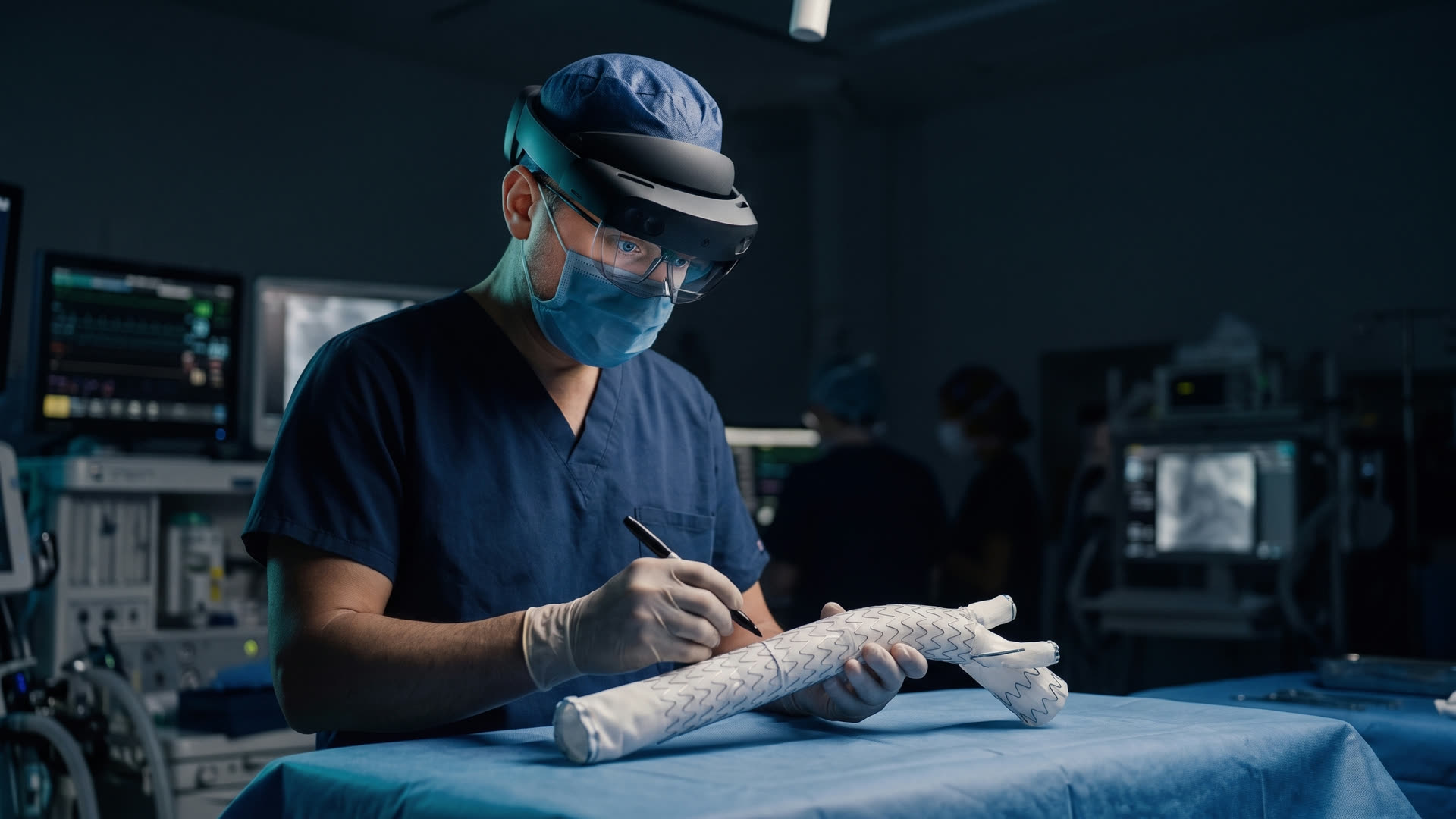
Hologram aorty pacjenta w polu widzenia operatora. Z angio-TK powstaje cyfrowy model aorty, który w goglach mieszanej rzeczywistości staje się hologramem: nawigacją podczas zabiegu i wirtualnym szablonem nakładanym na stent-graft przy jego modyfikacji. W 2019 r. przeprowadziliśmy pierwszy na świecie zabieg EVAR z nawigacją holograficzną. The patient's aortic hologram in the operator's field of view. A digital model of the aorta is built from CT angiography and becomes a hologram in a mixed-reality headset: navigation during the procedure and a virtual template overlaid on the stent-graft when it is modified. In 2019 we performed the world's first holographically-guided EVAR.
Model z tomografii, który wisi w powietrzu nad stołemA model from the CT scan, floating above the table
Punktem wyjścia jest segmentacja angio-TK: z badania powstaje trójwymiarowy model aorty pacjenta z gałęziami trzewnymi. W goglach mieszanej rzeczywistości model jest wyświetlany jako hologram w polu widzenia operatora, z sub-milimetrową rejestracją i kompensacją dryfu, więc operator widzi anatomię pacjenta, nie odrywając wzroku od pola operacyjnego. The starting point is CT angiography segmentation: the scan yields a three-dimensional model of the patient's aorta with its visceral branches. In a mixed-reality headset the model is displayed as a hologram in the operator's field of view, with sub-millimeter registration and drift compensation, so the operator sees the patient's anatomy without looking away from the surgical field.
Drugie zastosowanie jest przedmiotem patentu PL 242758: wspomagana komputerowo metoda wytwarzania i dopasowywania protez wewnątrznaczyniowych z użyciem wirtualnego szablonu aorty. Hologram odcinka aorty jest nakładany na stent-graft w goglach, a chirurg oznacza na protezie fenestracje dokładnie tam, gdzie odchodzą naczynia pacjenta. Patent jest ważny do 2041 r., a ochronę rozszerza międzynarodowa procedura PCT (WIPO). Technologię rozwija spółka spin-off PUM, HoloGraft sp. z o.o. The second application is the subject of patent PL 242758: a computer-assisted method of manufacturing and fitting endovascular prostheses using a virtual aortic template. The hologram of the aortic segment is overlaid on the stent-graft in the headset, and the surgeon marks the fenestrations on the prosthesis exactly where the patient's vessels branch off. The patent is valid until 2041, and protection is extended by an international PCT procedure (WIPO). The technology is developed by a PUM spin-off, HoloGraft Ltd.
Workflow w czterech krokachA four-step workflow
Z badania angio-TK powstaje cyfrowy model 3D aorty pacjenta; segmentację wykonuje oprogramowanie PrintGraft.A digital 3D model of the patient's aorta is built from the CT angiography; the segmentation is done by the PrintGraft software.
Model jest przycinany do odcinka docelowego, a na nim wyznaczane są odejścia naczyń, czyli przyszłe fenestracje.The model is cropped to the target segment and the vessel origins, the future fenestrations, are marked on it.
Hologram trafia do gogli mieszanej rzeczywistości i jest rejestrowany względem pacjenta lub stent-graftu, z kompensacją dryfu.The hologram is sent to the mixed-reality headset and registered to the patient or the stent-graft, with drift compensation.
Hologram prowadzi operatora podczas zabiegu albo osiada na stent-grafcie jako wirtualny szablon, na którym chirurg oznacza fenestracje.The hologram guides the operator during the procedure or settles on the stent-graft as a virtual template on which the surgeon marks the fenestrations.
Dowody, nie deklaracjeEvidence, not claims
Pierwszy taki zabieg na świecie, opisany w J Endovasc TherThe world's first such procedure, described in J Endovasc Ther
Zabieg, którego nikt wcześniej nie przeprowadziłA procedure no one had performed before
Najczęstsze pytaniaFrequently asked questions
Czym jest HoloGraft?What is HoloGraft?
Platforma mieszanej rzeczywistości: cyfrowy model aorty pacjenta, zbudowany z segmentacji angio-TK, jest wyświetlany w goglach jako hologram w polu widzenia operatora. Służy jako nawigacja podczas zabiegu i jako wirtualny szablon nakładany na stent-graft przy jego modyfikacji.A mixed-reality platform: a digital model of the patient's aorta, built from CT angiography segmentation, is displayed in a headset as a hologram in the operator's field of view. It serves as navigation during the procedure and as a virtual template overlaid on the stent-graft when it is modified.
Co chroni patent PL 242758?What does patent PL 242758 protect?
Wspomaganą komputerowo metodę wytwarzania i dopasowywania protez wewnątrznaczyniowych z użyciem wirtualnego szablonu aorty, czyli hologramu 3D nakładanego na stent-graft w goglach mieszanej rzeczywistości. Patent jest ważny do 2041 r., a ochronę rozszerza międzynarodowa procedura PCT (WIPO).A computer-assisted method of manufacturing and fitting endovascular prostheses using a virtual aortic template, i.e. a 3D hologram overlaid on the stent-graft in a mixed-reality headset. The patent is valid until 2041, and protection is extended by an international PCT procedure (WIPO).
Czym hologram różni się od drukowanego szablonu 3D?How does the hologram differ from a 3D-printed template?
Cel jest ten sam: precyzyjne wyznaczenie fenestracji na stent-grafcie pod anatomię pacjenta. Drukowany szablon (Metoda Szczecińska) jest fizyczną repliką aorty, na którą nakłada się protezę; hologram jest wirtualnym szablonem wyświetlanym na protezie w goglach. Patent PL 242758 dotyczy wariantu holograficznego.The goal is the same: precise placement of fenestrations on the stent-graft to match the patient's anatomy. The printed template (the Szczecin Method) is a physical replica of the aorta onto which the prosthesis is fitted; the hologram is a virtual template displayed on the prosthesis in the headset. Patent PL 242758 covers the holographic variant.
Czy metoda została zastosowana klinicznie?Has the method been used clinically?
Tak. W 2019 r. w USK nr 2 PUM przeprowadziliśmy pierwszy na świecie zabieg EVAR z nawigacją holograficzną, opisany w Journal of Endovascular Therapy. HoloGraft działa jako spółka spin-off PUM.Yes. In 2019 at USK No. 2 PUM we performed the world's first holographically-guided EVAR, described in the Journal of Endovascular Therapy. HoloGraft operates as a PUM spin-off.